

© AFP - Joao Filipe
Why 405 km/h on public roads forces mechanical evolution
In 1988, Peugeot engineers were losing sleep because their Group C cars were hitting 405 km/h on a public road. That record forced the installation of two chicanes on the Hunaudières straight in 1990, and it highlights exactly what the Circuit de la Sarthe is: an anomaly. Unlike modern, hermetically sealed permanent tracks, more than half of Le Mans consists of public roads like the D338 and D140, open to ordinary traffic most of the year.
Endurance racing has always been a forced march for reliability. When the Automobile Club de l'Ouest laid out the first provisional circuit in 1923, the goal was simple: test automobile durability by running cars for 24 hours straight. That year, 33 cars started, and the winning Chenard & Walcker covered 1,372 kilometers. A century later, winning cars cover nearly 5,300 kilometers.
The manufacturers and technology have completely transformed, but the core engineering problem remains exactly the same: build a machine that can survive 24 hours at the absolute limit.
The protest that killed the Le Mans Start
Until 1969, the standard starting procedure prioritized seconds over survival. Drivers lined up on the pit straight, sprinted across the track to their diagonally parked cars, and drove off with helmets half-fastened and belts largely ignored.

© DR - www.spirit-of-lemans.com
Jacky Ickx refused to participate in the gamble. On June 14, 1969, while the field sprinted, he walked slowly across the track, strapped himself in properly, and started dead last. He spent the next 24 hours dissecting the field. On the final lap, he passed Hans Herrmann’s Porsche 908 at Mulsanne Corner, winning by a margin of just 120 meters after 4,800 kilometers of racing.
During the very first lap of that same race, John Woolfe lost control of his Porsche 917 and was killed. He had not fastened his seatbelt. The traditional Le Mans start was abolished shortly after. Ickx won the race six times (1969, 1975, 1976, 1977, 1981, 1982), cementing the title "Monsieur Le Mans".
Privateer Math vs. Factory Budgets
While Alain Prost holds four Formula 1 World Championships, he never conquered Le Mans. His son, Nicolas Prost, took a completely different approach to the endurance problem.

© Shiv Gohil
In 2014, driving for the Swiss privateer outfit Rebellion Racing alongside Mathias Beche and Nick Heidfeld, Nicolas secured LMP1 privateer honors. They achieved this result against factory works programs armed with exponentially larger budgets. It was a masterclass in calculating endurance and extracting maximum performance without the safety net of massive factory infrastructure.
The 2 A.M. Pivot
Le Mans doesn't truly begin until 2 a.m. Around midnight, prototypes enter the forest sections hitting over 300 km/h in total darkness. The ambient temperature drops, the engine notes become heavier, and the mechanical strain peaks.
In the garages under cold white light, this is when the math gets critical. Strategists are constantly recalculating fuel margins, revising tire degradation estimates, and counting laps. This is the exact window when physical components break, strategies collapse, or crews manage to hold their margins together.
The edge cases
If you look at the historical data, the race produces highly specific anomalies:
-
The original sprint-across-the-track start still survives in a modified format in the 24 Heures Motos.
-
In 1966, a gap of only 20 meters separated the two leading Fords after 4,800 kilometers of racing.
-
Josh Pierson holds the record for the youngest driver to take the start, doing so in 2022 at just 16 years and 117 days old.
-
In 2025, the winning No. 83 Ferrari drove 5,273 kilometers in 24 hours—roughly 800 kilometers more than driving coast-to-coast across the United States.
-
Michelin secured its 28th consecutive victory in 2025 (a streak starting in 1998), matching the all-time record held by Dunlop.
Deploying Le Mans Classic Legend: July 2026
Three weeks after the 94th running of the 24 Hours, the Circuit des 24 heures reopens. From July 2 to 5, 2026, Peter Auto and the ACO are running the first edition of Le Mans Classic Legend under a new annual format.
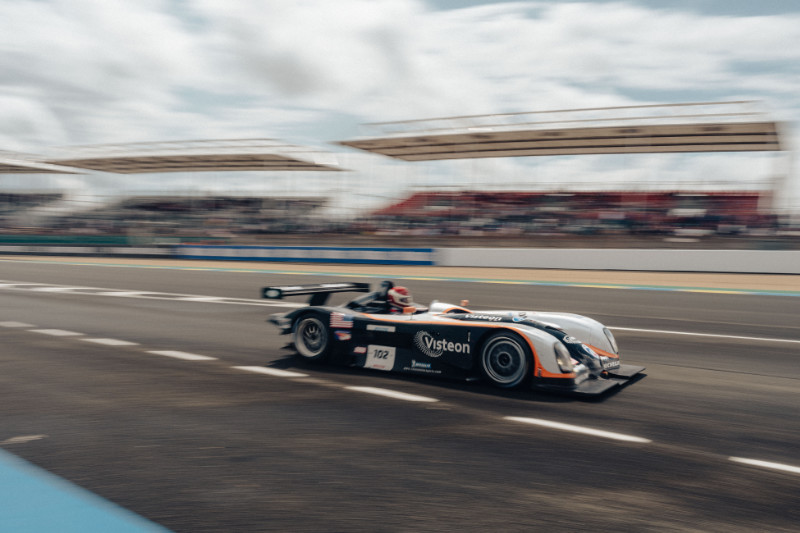
© Peter Auto - Le Mans Classic
They are putting five decades of racing history back under race conditions across five distinct grids. Instead of static museum displays, you will see the heavy aero profiles of the Porsche 935, the ground-effects of the 962, the screaming rotary Mazda 787B, and the precise engineering of the Audi R8 LMP racing prototypes tackling the circuit.
The 2026 guest of honor is Gordon Murray. To back that up, we are running a special parade featuring his most celebrated designs, including the McLaren F1 GTR that won Le Mans outright in 1995, and Ayrton Senna’s MP4/5B.
Le Mans Classic Legend — July 2 to 5, 2026, Circuit des 24 heures.
To live all these event with the best outfit, visit our new 2026 collection.


